|
Send E-mail |
Brooklands Museum Summer Project The Museum
The Brooklands Museum is situated on the site of the former Brooklands racetrack, which was also the main development and production area of the British Aircraft Corporation’s Weybridge Devision, formerly known as Vickers-Armstrong. Between 1907 and 1939 the racetrack built by Hugh Locke-King was one of the focal points of the British motorsport scene. The 3.5 mile long banked track being the first of its kind to be built in Europe. From 1908 on the area inside the track was seen as a perfect place to fly aircraft from and apart from many other famous aviation names that flew from Brooklands, it became the home of the Vickers Aircraft Factory. Famous in the Second World War for the Wellington bomber, after the war the successful Viking, Viscount and VC10 were built here. Next to this, after the consolidation of the British Aircraft industry into BAC the site remained an important design office, working amongst other projects on Concorde. The Museum is located on a large area on the north side of the original racetrack, and includes the original Member’s Banking and the 1930’s clubhouse as well as several other buildings connected to either the motoring or the aviation heritage of the site. In and around these buildings a large collection of cars, aircraft and other items is displayed, including the only surviving Wellington Bomber that actually saw service in the Second World War.
The Brooklands Museum summer project was conceived in early 1998 to achieve a double goal; firstly it would provide European aeronautical engineering students with practical engineering experience, and also it would provide the museum with a very valuable workforce through which the life of the exhibits can be extended. During the project the students worked in small groups around the museum on several different tasks. They were supervised by museum volunteers, usually retired licensed aircraft engineers or volunteers with experience in the engineering environment. With Mike Roach as the link between the museum and the schools, students from Hogeschool Haarlem in The Netherlands, ESTACA and EPF in France were given the opportunity to gain experience in several restoration tasks. 1998 Project Participating
students: 8
1. The students involved in the 1998 project.
1. The next step was a bit of painting. Part of the painting crew is shown.
All photos J. Hieminga except where noted 1999 Project Participating
students: 18
1. The students involved in the 1999 project with 'Ginger' Wright and Julian Temple.
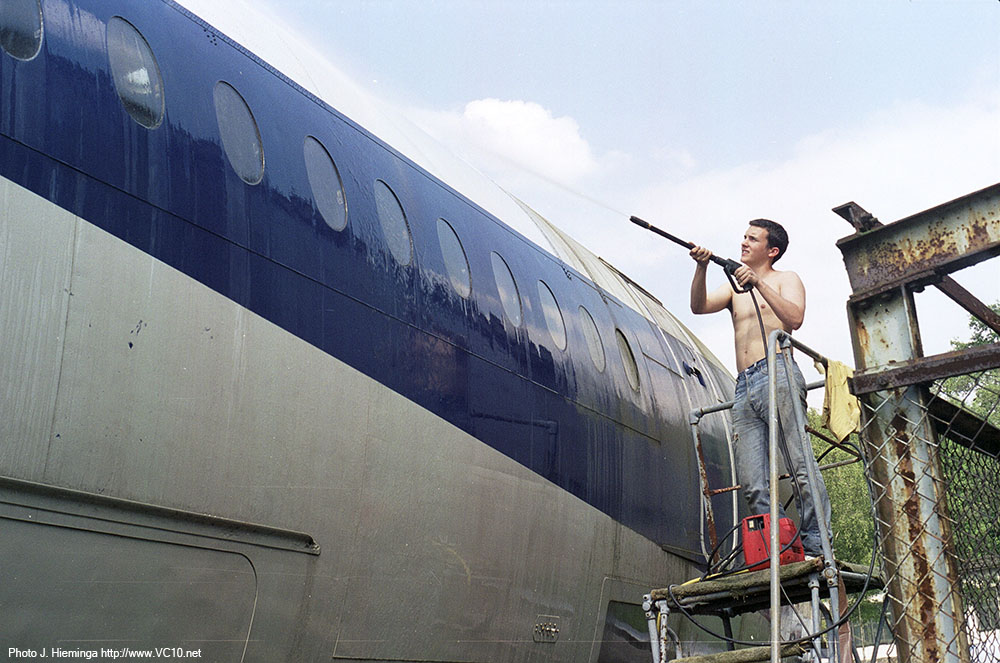
1. Painting after corrosion removal on the VC10 fuselage. The access equipment in use
shows a variety of airline markings.
1. Julian Temple, Famke, 'Ginger' Wright, Mike Roach, Jasper, Wouter and Francois. These four students spent three months at the museum as an internship project while other groups rotated for shorter periods.
All photos J. Hieminga 2000 Project Participating
students: 11
1. Some
of the students involved in the 2000 project in front of BAC 1-11 G-ASYD. All photos J. Hieminga 2001 Project
Participating students: 13
1. This time Vanguard G-APEP is the background for
a group photo of some of the 2002 students.
1. The spoiler/speedbrake area on BAC 1-11 G-ASYD is the
focus of some cleaning work. All photos J. Hieminga except where noted 2003 and 2004 Projects Unfortunately there never was a 2003 Summer Project, the available budget just didn't allow this. 2003 saw several large projects pending at the museum some of which were the refurbishment of the Wellington Hangar, a listed building from the WWII era, and the imminent arrival of Concorde 202 G-BBDG which was due to be restored at the museum. Also the resident Hawker Hurricane restoration was slowly progressing. There were many more things going on at the museum and as an organisation largely driven by volunteers and donations, money is always tight. For this same reason there would not be a 2004 project, however unfortunate this was for the students that would have liked to participate. More student projects? Since 2002 the project has not been active in the form as described above, but the restoration of Concorde G-BBDG has benefited a lot from the involvement of students from a local university. It is therefore safe to say that the lessons learned have not gone to waste. Even if economics have been against running any more student projects at the museum, there's no telling what the future will hold and I'm sure that in time there will be more to report on this front. For more information about what's going on at the museum have a look at their excellent website: Brooklands Museum.
|